When electrical faults occur in your rental apartment, it is important to understand who is responsible for what. The tenant is responsible for electrical faults caused by their own appliances, overloaded circuits and damage from negligence. The landlord takes care of problems with main installations, fuse boxes and permanently installed lighting. Knowing the division of responsibilities will help you to act correctly and avoid unnecessary costs when electrical problems occur.
What counts as the tenant's responsibility in case of electrical faults?
As a tenant, you are responsible for electrical faults caused by your own electrical appliances, overloading of circuits and damage caused by your own negligence. This includes faulty household appliances, broken cords and problems that arise when you plug too many devices into the same socket.
You are also responsible for replacing light bulbs and other loose lighting sources that you have installed yourself. If you have connected your own electrical installations without authorization and these cause problems, the repair costs fall on you.
The dividing line between your and your landlord's responsibilities lies in what counts as fixed installation versus movable property. Anything you have bought and installed yourself, such as table lamps, electronics and household appliances, is your responsibility. Permanently installed components such as electrical sockets, fuses and fixed lighting belong to the landlord.
If you are unsure who is responsible for a specific electrical fault, contact your landlord to discuss the situation before ordering repairs yourself.
When should landlords fix electrical faults in rental properties?
The landlord is responsible for all electrical faults relating to the basic installations and fixed electrical systems of the apartment. This includes problems with fuse boxes, electrical sockets, switches, fixed ceiling lights and main electrical wiring.
According to the Tenancy Act, the landlord must keep the apartment in good condition and ensure that all installations work safely. If fuses blow frequently, electrical sockets don't work or there are problems with the main power supply, it is the landlord's responsibility to arrange repairs.
The landlord must also remedy electrical faults that may pose safety risks, whatever the cause. If there is a risk of fire or electric shock due to faulty installations, the landlord has a duty to act immediately.
You have the right to claim a reduction in rent if the landlord fails to rectify electrical faults within a reasonable time and the problems significantly affect your use of the apartment. Always document electrical problems and your contact with the landlord.
What should you do when an electrical fault occurs in your rental apartment?
When you discover electrical faults in your apartment, immediately check if there is any safety risk and document the problem carefully. Switch off affected circuits if there is a risk of danger and avoid using faulty sockets or appliances.
Follow these steps when electrical faults occur:
- Check the fuse box - See if any fuse has blown and try to reset it
- Test other outlets - Determine if the problem is local or multi-circuit
- Document with photos - Take pictures of the problem area and any damage
- Contact the landlord - Report the problem in writing with a description and pictures
- Assess if it is an emergency - In case of safety risk, contact electrician immediately
If the problem seems to be caused by your own appliances, disconnect them and test if the fault persists. This will help you determine whether it is your responsibility or the landlord's to fix the problem.
For minor problems that do not pose a safety risk, you can wait for the landlord's response. For emergency situations that could pose a danger, you should act immediately and inform the landlord afterwards.
Which electrical faults can be dangerous and require immediate action?
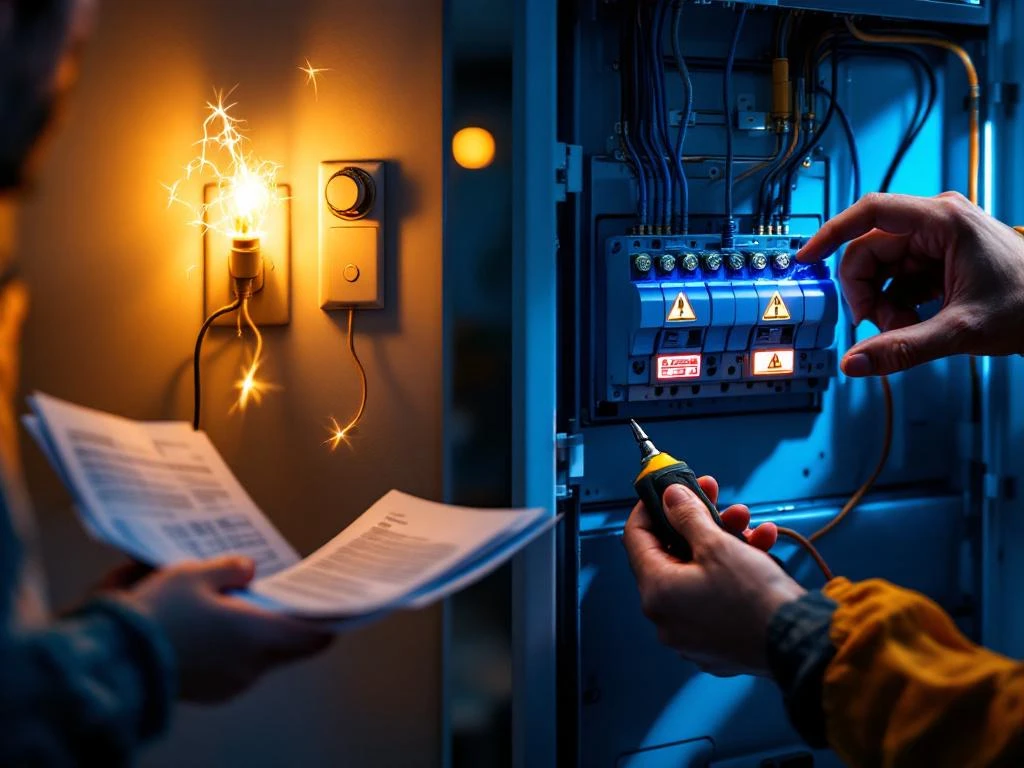
Some electrical faults pose immediate safety risks and require urgent action. Sparks from sockets, burns on electrical outlets, recurrent fuse blowing and strange smells from electrical installations are all signs of serious problems that can lead to fire or electric shock.
These electrical faults require immediate attention:
- Sparks or arcing from sockets, switches or appliances
- Burns or soot stains around electrical outlets and switches
- Recurrent fuse blows without apparent cause
- Strange smells like burnt rubber or plastic from electrical installations
- Heat generation from sockets, cables or cabinets
- Electric shocks from appliances or installations
In these situations, immediately turn off the power to the affected area via the fuse box. Do not use the affected outlets or appliances and contact a qualified electrician immediately, regardless of who is responsible for the repair.
Always call 112 if there are signs of fire or if someone has been electrocuted. Your safety is more important than finding out who is responsible for the cost.
How 24 centers help with electrical emergencies and safety
We offer professional electrical assistance around the clock when emergency electrical faults occur in your rental apartment. Our qualified electricians handle both safety-critical situations and common electrical problems with a short response time.
Our services include:
- Emergency power failures and fuse replacements - Fast response to power outages and safety issues
- Safety checks - Checking electrical installations and identifying risks
- Electrical sockets and switches - Repair and replacement of defective components
- Fuse boxes and main installations - Professional handling of major electrical problems
- Electronic security systems - Installation of locking and alarm systems
With our local focus and extensive network, we can get to you quickly at any time of day or night. Our technicians understand the responsibilities of both tenants and landlords and can help you navigate who should pay for different types of repairs.
Call 08 40 24 240 for immediate assistance with emergency electrical faults or visit the 24 center to book online for scheduled checks and installations. We help you solve electrical problems safely and efficiently, no matter who is responsible.
Frequently asked questions
What is the cost if I accidentally call an electrician for a problem that the landlord has to pay for?
If you order electricians for a problem that later turns out to be the landlord's responsibility, you can usually bill the landlord for the cost if the repair was necessary. Keep all receipts and documentation. To avoid this, always contact the landlord first in case of uncertainty about responsibilities.
How long can the landlord wait to fix non-emergency electrical faults?
Landlords must fix electrical faults within a reasonable time, usually within a few days to a week depending on the extent of the problem. If the repair takes longer than 2 weeks without a valid reason, you may be entitled to a rent reduction. Always document when you reported the problem.
Can I change the fuses in the fuse box myself or does an electrician have to do it?
You may replace fuses of the same type and rating as the original, but not modify or install new fuses. If fuses blow frequently or you are unsure of the cause, contact an electrician as this may indicate a larger problem that requires professional investigation.
What if my old fridge blows a fuse - who pays to fix it?
If your own appliance causes a fuse to blow, it is your responsibility to fix the problem, either by repairing or replacing the appliance. However, if the old appliance has caused damage to the apartment's electrical installation, the responsibility may be more complex and require discussion with the landlord.
How do I know if a socket is broken or if it's just my appliance that's not working?
Test the socket with another appliance that you know works, or test your appliance in another socket. If the socket does not work with several different appliances, it is probably defective and falls under the landlord's responsibility. If only your appliance does not work in different sockets, the problem is with the appliance.
Do I have to pay for an electrician even in case of an emergency electrical fault that poses a safety risk?
In case of safety emergencies, always prioritize safety and contact electricians immediately. The responsibility for the costs will be determined afterwards based on the cause of the problem. If the fault is due to the apartment's installations, the landlord pays, if it is due to your appliances, you pay. Document the situation carefully.
Can I install extra electrical outlets myself in my rental apartment?
No, installing new electrical outlets is considered electrical installation work that requires a qualified electrician and landlord approval. Installing your own electricity without permission can make you liable for damage and may also affect your insurance cover. Contact the landlord to discuss the possibility of having new sockets installed.