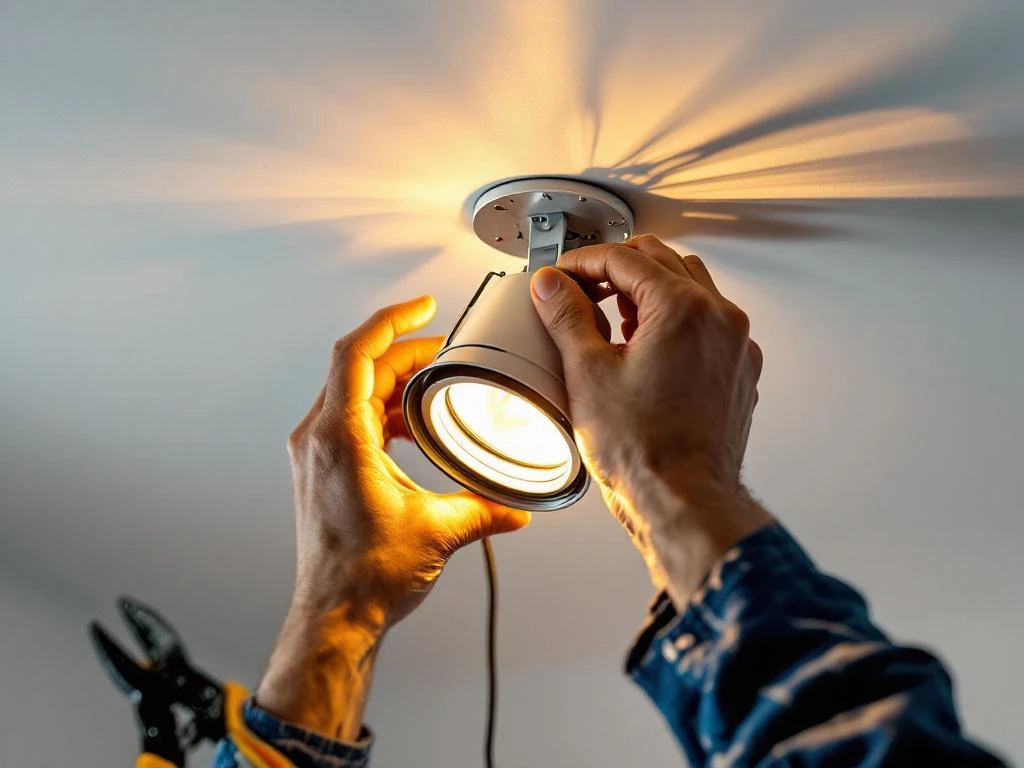
Wiring spotlights to the ceiling requires the right tools, safe power management and proper wiring. You'll need a voltage locator, drill, screwdriver and safety equipment for a safe installation. The process involves turning off the power, checking the cables, connecting the correct color-coded wires, and securing all connections properly.
What tools and materials do I need to connect a spotlight to the ceiling?
For a safe spotlight installation, you need basic power tools and safety equipment. Voltage detectors are the most important tool to check if there is current in the cables. You will also need a drill with a wood drill bit, screwdrivers with insulated handles, a ladder and possibly a hole saw for larger spotlights.
Materials required include spotlights, cables (if existing ones are not enough), terminal blocks for secure cable connections and appropriate fuses. Safety equipment such as safety glasses and gloves are also essential. Make sure your ladder is stable and at the right height to reach the ceiling lights safely.
The quality of tools affects both safety and performance. Cheap voltage locators can give incorrect readings, creating danger. Invest in reliable tools from well-known brands for electrical work.
How do I know if there is power in the cables before I start installing the spotlight?
Checking the power supply is always done with a voltage detector before touching the cables. Switch off the correct fuse in the switchboard and test the voltage detector on a known power source to verify that it works. Then check the wiring where you will install the spotlight.
After switching off the fuse, wait a few minutes before testing the cables. Some electrical components can store current for a short time. Test both between phase and neutral and between phase and earth to ensure that all current is gone.
Always double check by testing the voltage detector again on a known power source after the check. This confirms that the tool is still working correctly. Always treat cables as live until you are absolutely sure that the power is off.
What safety rules do I need to follow when installing roof lights?
Electrical safety rules for overhead lighting start with always turning off the power at the main fuse before starting work. Use personal protective equipment such as insulated tools, safety glasses and rubber gloves. Never work alone on electrical installations.
When working at height, a stable ladder or scaffold is required. Place the ladder on a level surface and never let anyone else use the ladder at the same time. According to the Swedish Electrical Safety Authority's regulations, private individuals may carry out minor electrical work in their own homes, but the installation of new circuits requires a qualified electrician.
Always check local building codes and electrical safety regulations. Some municipalities have stricter rules for your own electrical work. Document your work and have the installation checked by a qualified electrician if you are unsure of the results.
How do I connect the cables correctly for spotlight installation?
Correct cable connection follows Swedish color coding: brown cable is phase (L), blue is neutral (N) and yellow-green is earth (PE). Connect cables of the same color with terminal blocks that are screwed tight. Check that no copper cables are protruding from the terminal block.
Always start with the earth cable (yellow-green), followed by the neutral (blue) and finally the phase (brown). This reduces the risk of short circuits during installation. Use the right size of terminal block for the cable area - too small terminals result in poor contact and overheating.
Test all connections by pulling lightly on the cables after assembly. They should stay in place without moving. Wrap all terminal blocks in insulating tape or place them in a suitable junction box to protect the connections.
When should I hire an electrician instead of installing spotlights myself?
Hire a licensed electrician when the installation requires new circuits from the switchboard or work on main fuses. Complex installations with dimmers, multiple spotlights on the same circuit or integration with smart home systems require professional expertise.
Legally, as a private individual, you can change existing light fittings and carry out minor repairs in your own home. However, the installation of new circuits, work in wet areas or changes to the electrical panel must be carried out by a qualified electrician under Swedish law.
If you are unsure about any aspect of the installation, contact an electrician. Incorrect electrical installation can cause fire, electric shock or damage to electronics. The cost of professional installation is often less than the cost of repairing damage from incorrect installation.
How we help with professional spotlight installation
We at 24 Center offer professional spotlight installation with qualified electricians ensuring safe and proper ceiling lighting. Our technicians handle all types of electrical installations, from simple spotlight replacements to complex lighting systems with dimmers and smart controls.
Our services include:
- Safe installation of spotlights and ceiling lights
- Checking existing electrical circuits and fuses
- Installation of new circuits if needed
- Integration with smart home systems
- Guarantee on all work carried out
With our 24/7 service, you get help when you need it, even for urgent electrical problems. We are available throughout Sweden with a local presence and in-depth knowledge of the electrical conditions of different types of buildings.
Contact us on 08 40 24 240 for immediate help with your spotlight installation or book online for planned electrical work. We make it easy to get professional, safe electrical installation when you need it.
Frequently asked questions
How do I know which type of spotlight is suitable for my roof type?
For concrete ceilings, you will need special drills and dowels, while plasterboard ceilings require molly plugs or drywall anchors. Measure the thickness of your ceiling and check the mounting depth of the spotlight. For older ceilings with glulam beams, you can often screw directly into the wood, but avoid pipes and electrical wires.
What to do if the spotlight does not work after installation despite correct wiring?
First, check that the fuse is switched on and that the LED works by testing it in another luminaire. Verify all cable connections with a voltage detector and check that the terminal blocks are tight. If the problem persists, it may be a faulty luminaire or circuit failure.
Can I connect several spotlights on the same circuit and how many are safe?
Yes, you can connect several spotlights in parallel on the same circuit. For a 10A fuse, you can safely have up to 15-20 LED spotlights (depending on power). Count total wattage consumption and make sure not to exceed 80% of the fuse capacity for safe operation.
Do I need special spotlights for the bathroom or kitchen?
Yes, in wet areas, spotlights with an IP44 rating or higher are required to withstand moisture and splash water. In the shower zone, at least IP65 is needed. Always check the product specification and follow local building regulations for wet areas before installation.
How deep should I drill the hole for a recessed spotlight?
The drilling depth depends on the height of the spotlight plus insulation. Usually 8-12 cm depth is needed for standard LED spotlights. Measure your specific model and add 2-3 cm for ventilation. Make sure there is enough space above the ceiling before you start drilling.
What is the cost of having an electrician install spotlights compared to doing it yourself?
Self-installation costs only materials (200-500 SEK per spotlight), while electricians charge 800-1500 SEK per spotlight including labor. For complex installations or new circuits, the cost can be SEK 3000-5000. Weigh the cost against the safety and guarantee of the work.
Can I install dimmers together with LED spotlights?
Yes, but you must use an LED-compatible dimmer as ordinary dimmers can cause flicker or damage. Check that both dimmer and spotlights are labeled as compatible. Installation of dimmers often requires extra wiring and should be done by an electrician for safety.